Give the sale a job
A scheduled sale can support a growth plan by giving the team a defined offer window, a reviewed product selection and time to prepare the customer journey. It also creates a repeatable event you can evaluate afterward. Its value starts with coordination: the prices, campaign page, email and deadline can be planned together.
Choose a specific commercial job. You might want to introduce an overlooked range, clear selected seasonal variants or give returning visitors a reason to reconsider a product. Record what a useful result would mean before selecting the percentage. “More orders” alone can hide a promotion that simply gives a discount to customers who would have bought anyway.
Scheduling is an operating tool. Whether it helps sales or profit depends on the offer, audience, execution and costs. Keep those assumptions visible so the campaign produces a decision you can use next time.
Use deadlines with context
A real ending can make the terms easier to understand: the shopper knows what qualifies and how long the price is available. Place that information beside the decision it affects. A visitor comparing products may need fit, materials and delivery details before a prominent clock becomes useful.
A 2023 study by Yi, Jiang and Zhou combined a randomized field experiment at a Chinese apparel retailer with a 185-person laboratory experiment. Time restrictions and popularity cues interacted differently with shopping-goal specificity, inferred from browsing in the field. Outcomes included clicks, add-to-cart behaviour and laboratory purchase intention, rather than completed-purchase profit. The findings do not establish a universal countdown conversion lift.
Treat a countdown as a testable communication choice. Keep a fixed deadline across visits, explain the eligible range and let the offer end as stated. An endlessly resetting clock cannot accurately explain a fixed campaign window. Our countdown setup guide covers placement and expiry checks.
Protect contribution first
Start with the amount left after variable costs. In this fictional example, a product sells for $100 and has $60 of variable cost per order. That leaves $40 before fixed overhead. A 10% markdown leaves $30; a 20% markdown leaves $20, assuming variable costs remain unchanged.
Illustrative arithmetic, not merchant results. Variable cost is fixed at $60 here; include the relevant product, payment, fulfilment, shipping subsidy and expected return costs in your own model.
If the baseline is 100 orders at $40 contribution, the target is $4,000. At $30 each, you need at least 134 whole orders to reach that target. At $20 each, you need 200. That is the volume hurdle the offer must clear before allowing for any additional campaign cost.
Set a price floor and a budget for the test. A larger order count is useful when its contribution supports the goal; the discount depth itself is not a growth result.
Make the offer legible
Write the offer as a sentence a customer can repeat: “Selected travel bags are 15% off until Sunday at 8pm, store time.” Show the intended variants, the actual selling price and a route to the participating range. Keep exclusions visible near the offer rather than relying on a support conversation to explain them.
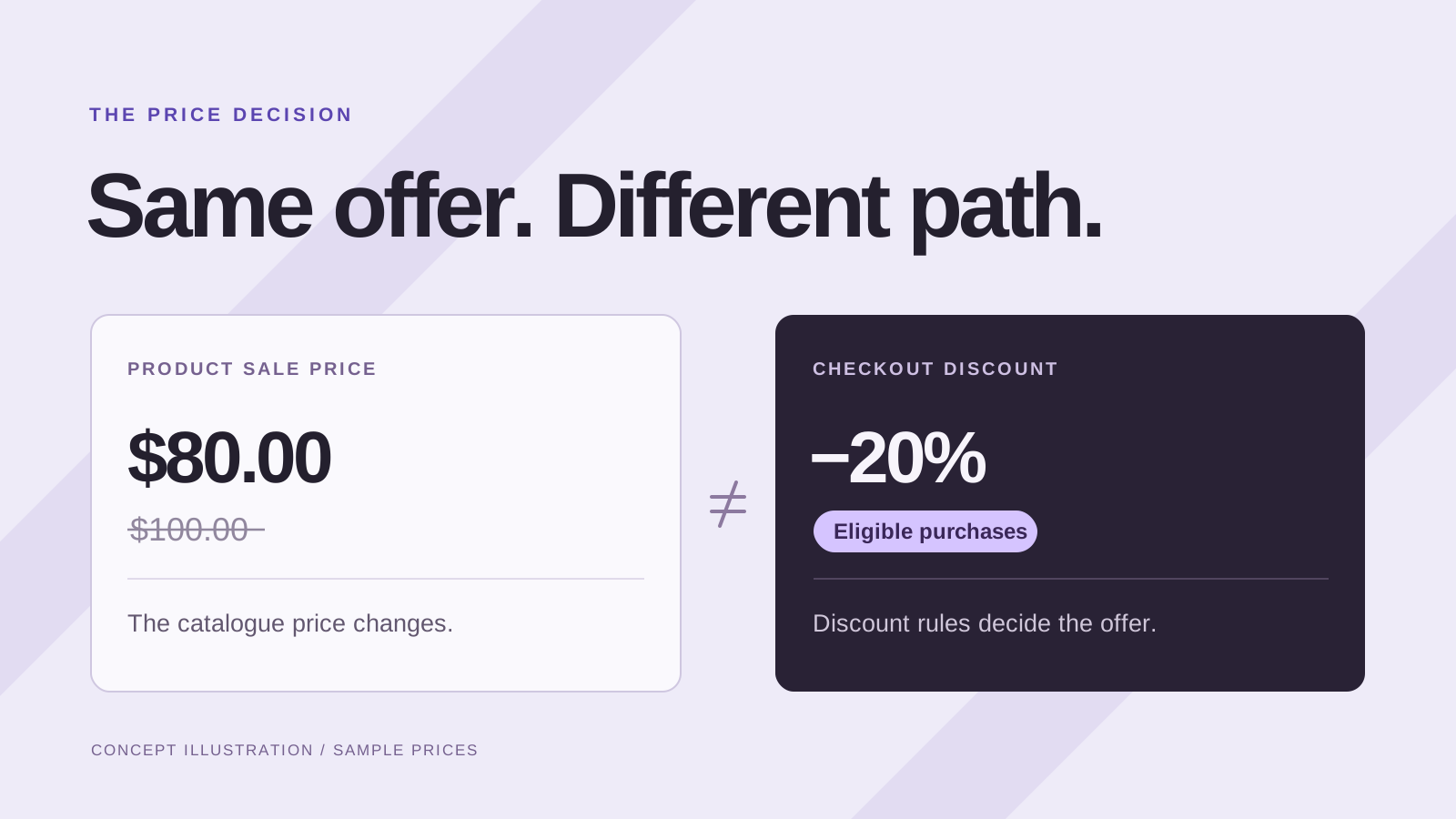
Choose the mechanism that matches those terms. A catalogue price change fits a public markdown on selected variants. A customer condition, code or basket threshold may call for Shopify’s discount tools. Shopify documents native amount-off discounts with active dates; a separate scheduler is not necessary for every offer.
Compare a product page, collection card and cart before launch. Their presentation can differ, and existing offers can affect the final amount. Use the sale-price versus automatic-discount guide to define the intended experience, then test one included variant and one exclusion on mobile.
Run a reviewed window
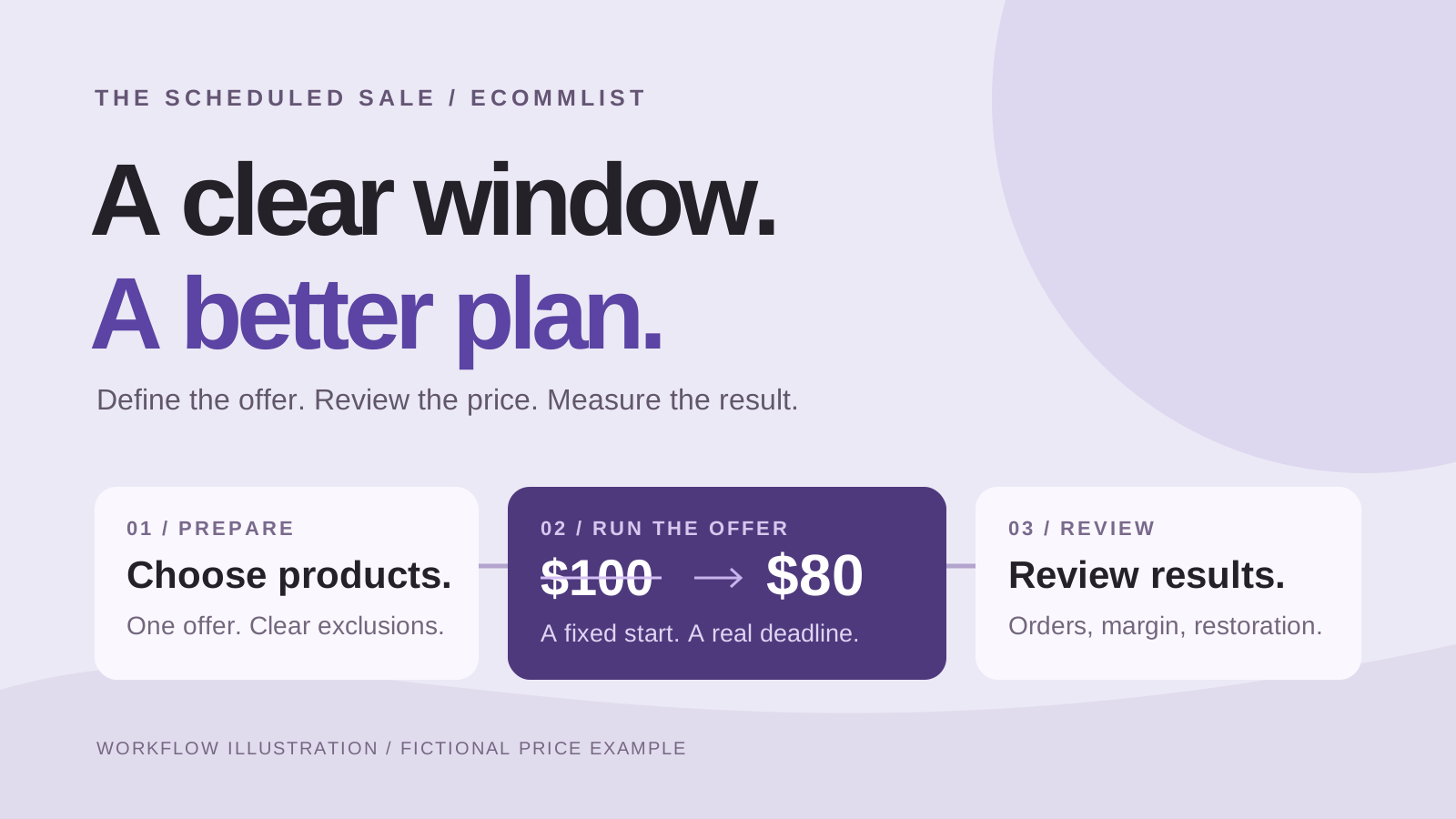
SaleSwitch — Sale Scheduler is our app for scheduled percentage changes to base catalogue prices in shop currency. Select products or variants, review the proposed price pairs, set dates and approve the campaign. Optional countdowns and sale collections can support the storefront explanation. Countdown placement still needs to be saved in the theme editor.
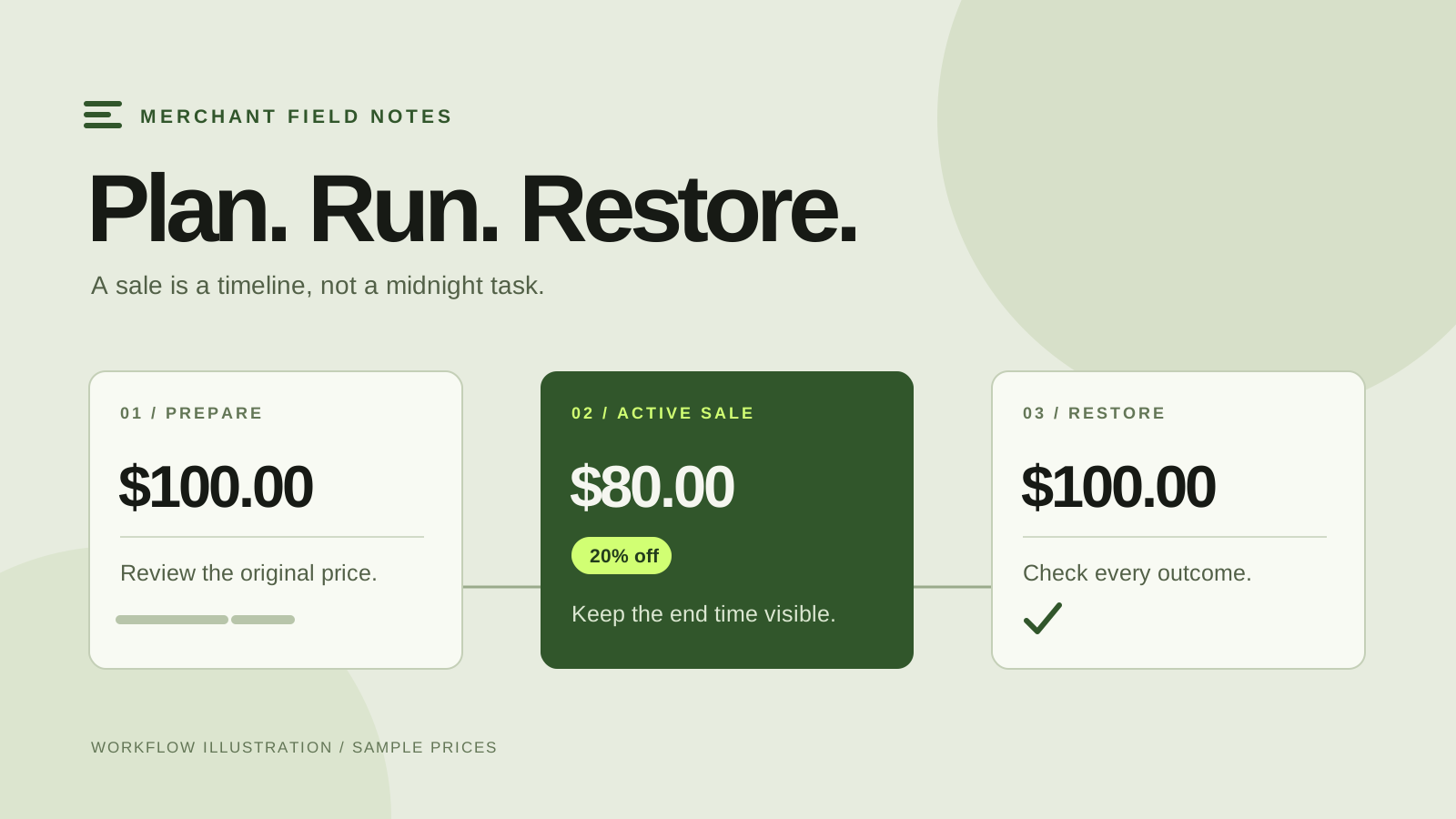
Leave room to inspect execution. Price changes are queued and can take minutes across a larger selection or during retries. At the end, SaleSwitch restores acknowledged original price pairs when the current pair still matches the sale pair it applied. Detected later edits are preserved and flagged for review. Check outcomes rather than treating the deadline alone as confirmation.
Start with a selection you can evaluate. Free includes two scheduled sales per UTC month and up to 50 variants per sale; Pro is $9.99 USD per month with up to 200 variants per sale. The fictional demo shows the workflow before you connect a store.
Measure more than revenue
Track completed orders, net sales after returns, contribution after campaign costs and any change in customer acquisition cost. Separate new and returning customers when the sample allows. Note stockouts, shipping changes and other promotions that could explain the result.
Choose a comparison before launch. A randomized, genuinely isolated holdout can help estimate incremental impact when the offer and your tools allow it. A public catalogue markdown is visible to everyone, so a group that merely receives no email may still buy at the sale price. That comparison estimates the extra effect of the message more directly than the total effect of the sale.
If isolation is impractical, compare with a documented baseline and label the conclusion directional. Weekday demand, seasonality and traffic mix can change alongside the promotion. Review the following period too: an apparent win during the sale may include purchases brought forward from later weeks.
A repeatable sale earns its place in the calendar when the measured contribution supports the job you gave it.
Keep the learning
Save the brief, approved prices, actual execution window and final results together. Record one decision: repeat, revise or stop. Change a small number of variables in the next test so the comparison remains useful.
For a seasonal range, the decision might be to narrow the selection instead of increasing the discount. For a successful small campaign, the next question might be whether the result holds for another audience. Use the scheduling workflow for execution and the 2026 Black Friday strategy guide for a larger campaign plan.